
Revestimientos de trituradora HSI
Resumen
Los trituradores de impacto de eje horizontal (HSI) utilizan un rotor giratorio de alta velocidad con elementos de impacto para romper el material por colisión. El material es acelerado por el rotor y choca contra superficies metálicas reemplazables, lo que resulta en una alta relación de reducción y produce un producto final de forma cúbica. Las velocidades de impacto en los trituradores HSI suelen oscilar entre 30 y 80 m/s, mucho más altas que en la trituración por compresión, lo que conduce a una reducción eficiente del material pero a un desgaste significativo en ciertas partes. La selección de las piezas de desgaste correctas es esencial para un rendimiento óptimo de la trituradora y la fiabilidad operativa, y debe basarse en las características del material, la abrasividad, la presencia de objetos extraños y el tamaño del producto objetivo.
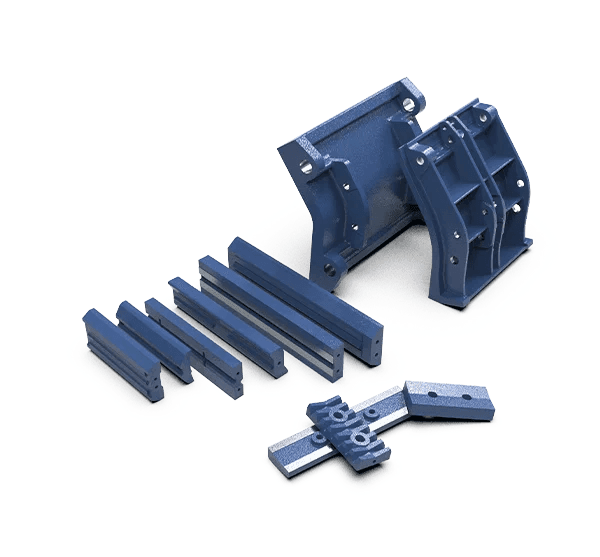
Materials
Wear parts for HSI crushers are manufactured from a range of engineered materials to provide the best balance between wear resistance and impact toughness:
- Manganese Steel: Offers superior impact resistance and work-hardening properties. Suitable for large feed sizes, high-impact conditions, and feeds with potential unbreakable objects.
- Martensitic Steel: Provides an excellent combination of hardness and toughness. Commonly used in applications requiring improved wear resistance over manganese steel, especially with abrasive feed.
- High Chrome Steel (White Cast Iron): Delivers high hardness and outstanding wear resistance for low-impact, high-abrasion environments. Not recommended when feed contains metallic contaminants or large unbreakable objects due to brittleness.
- Composite Materials with Ceramic Inserts: Integrate hard ceramic particles within a metal matrix to significantly increase service life in highly abrasive applications, while maintaining the necessary structural integrity.
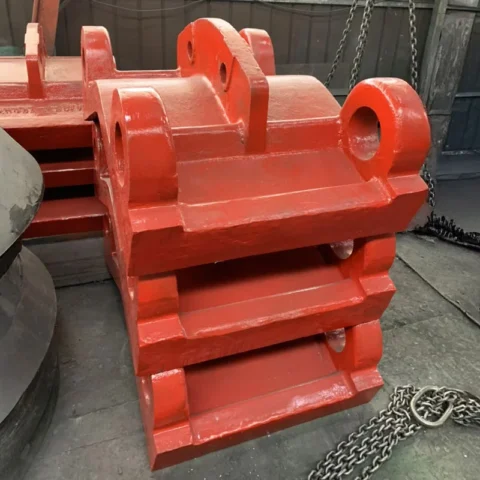
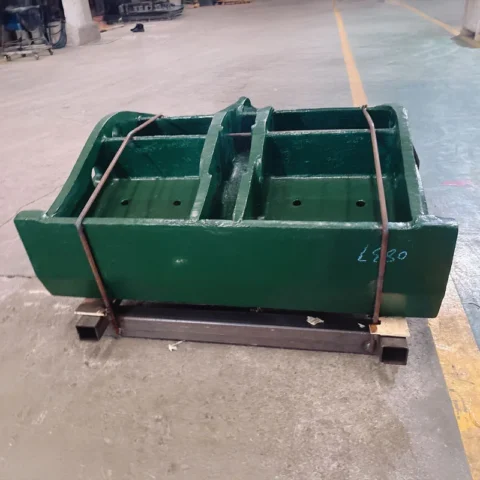
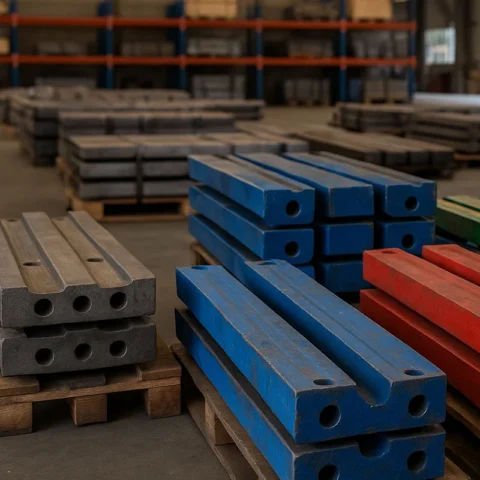
Wear Parts Categories
- Blow Bars: The primary impact components mounted in the rotor, directly striking and breaking the material. Blow bars are subject to the highest impact and abrasion. Their shape, material, and mounting method influence wear patterns and crusher efficiency.
- Breaker Plates / Liners: Fixed impact surfaces inside the crushing chamber, against which material is thrown and further reduced. Breaker plates are fitted with replaceable liners to extend operational life.
- Apron Liners: Positioned in primary and secondary crushing zones, these liners help control product size and provide overload protection.
- Side Liners (Frame Liners): Protect the side walls of the crushing chamber and mainframe from wear and abrasion.
- Other Wear Parts: Depending on application, may include feed liners, discharge lips, or other protective elements within the crushing system.
Supported Crusher Models
| Brand | Model |
|---|---|
| BOEHRINGER | 1400, RC-14 |
| Eagle | 1400, UM05, UM15, UM25, UM45 |
| Hazemag | AP4, APK30, APK40, APK20, 1620, SAP2, SAP1, APK60, 252, APP1013, AP1115, 1022, 1114 |
| Kleemann | MR100, MR110, MR110 EVO, MR122, MR130, MR130 EVO, SPH10, SNH16 |
| Metso | LT1213, NP1007, NP1110, NP1210, NP1213, NP1313, NP1315, NP1415, NP15, NP1520, NP1620, NP2023, LT1315 |
| Minyu | MIC102092, MIC102115, MIC102152, MIC133076, MIC133092, MIC133115, MIC133152, MIC133184 |
| Missouri Roger | 5660 |
| Pulvomatic | 42 |
| Rexnord | HS1310, HS1315, HS1415 |
| Rubber Mater | RM120, RM80, RM100 |
| Sandvik | QI441, Unknown, CI41, CI51, CI722, CI512, QI440 |
| Shanghai | PF1010, PF1210, PF1214, PF1315 |
| Striker | 0907, SCE1112-1312 |
| Terex | I-111, I-120, I-130, TRAKPACTOR428, XH250, XH320, XH320SR, XH500, I-140, I1312, CR015 |
| Tesab | 1012TS, 1412TCC |
| Universal | 130/150, 74125, HMM-5136 |
| Shaorui | SF1315 |
| Ru Brands | SMD75, DR100 |
| Telsmith | HS5252 |
| GIPO | 202, 203, R131, 201 |
| Trio | 4034 |
Technical Glossary
- Horizontal Shaft Impactor (HSI): A type of crusher that uses a horizontal rotating shaft fitted with impact elements to crush material.
- Rotor: The rotating assembly of the crusher that holds and drives the blow bars.
- Blow Bar: The main wear component that impacts and fractures incoming material.
- Breaker Plate: The surface inside the crusher chamber that material is projected against for further reduction.
- Apron: An adjustable element in the crushing chamber for controlling product size and protection.
- Setting: The gap between the tip of the blow bar and the breaker plate or apron, which determines product size and crusher capacity.
- Wear Resistance: The ability of a material to withstand abrasion and maintain functionality.
- Impact Resistance (Toughness): The ability of a material to absorb energy and resist fracture under impact.
- Feed Size: The maximum particle size entering the crusher.
- Abrasiveness: The measure of how much the material causes wear on the crusher’s surfaces.
- Uncrushable Material: Any foreign object within the feed that cannot be broken by the crusher and may damage wear parts.