Why Choosing the Right Crusher Wear Parts Manufacturer Actually Matters
Let me be straight with you: I’ve seen plenty of quarry operations go through three suppliers in a single year. And the issue almost never came down to price. It came down to consistency.
Wrong supplier choices show up in ways that hurt. Liners that crack after two weeks. Jaw plates that don’t fit the mounting without grinding. Cone liners that arrive six weeks late while your machine sits cold. These aren’t edge cases — they’re what happens when a buyer picks a manufacturer based on a catalog photo and a low quote.
The real cost isn’t the part. It’s the downtime. A crusher sitting idle for two days in a granite quarry costs more than the entire set of liners you were trying to save money on. The wrong wear part supplier doesn’t just cost you money once — it costs you every time the machine stops.
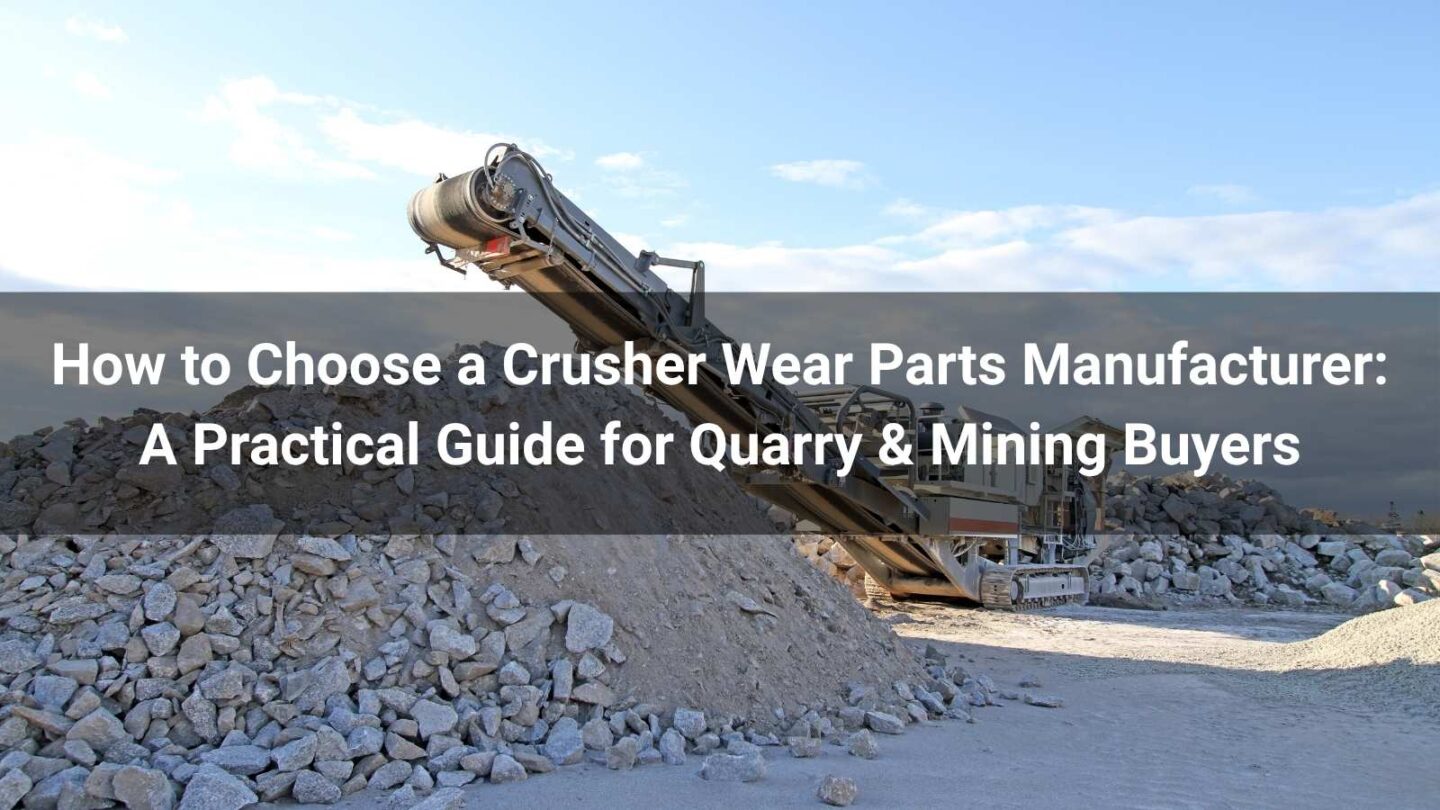
This guide walks through what actually separates a reliable crusher wear parts manufacturer from one that looks good until the parts show up. We’ll cover materials, manufacturing capability, quality control, lead times, and how to evaluate a supplier before you commit to a production order.
Start With Materials: Does the Manufacturer Actually Understand Wear?
Material selection is where most of the difference in liner performance lives — and it’s also where a lot of suppliers get it wrong, or worse, tell you what you want to hear.
The main alloys in crusher wear parts are high manganese steel (Mn13, Mn18, Mn22), high chrome iron, martensitic steel, and more recently, MMC (metal matrix composite) and ceramic composite materials for extreme abrasion applications. Each of these has a purpose. None of them is the right answer for every application.
Here’s something that catches a lot of buyers off guard: higher manganese content doesn’t automatically mean more wear resistance. Manganese steel works through work hardening — under impact, the surface hardens progressively. If your application doesn’t generate enough impact stress (say, you’re crushing rounded river pebbles rather than sharp granite), Mn22 won’t harden the way it’s supposed to. You’d actually get better service life from Mn13 in the right conditions.
A manufacturer that knows what they’re doing will ask you questions before they quote. Feed material type. Feed size range. Hardness and silica content. Moisture levels. Closed-side setting. Production throughput. These details determine which alloy profile actually makes sense for your liner.
If a supplier takes your crusher model number, sends a price, and never asks about your feed, that’s a red flag. Not because they’re necessarily dishonest — but because they’re treating your application as a commodity, and commoditized parts don’t perform the same as engineered ones.
Different materials for common crushing environments:
Granite and hard rock quarrying — typically benefits from Mn18 or high-chrome iron depending on impact level. High silica content means abrasion is the primary wear mode.
River gravel / rounded aggregate — lower impact, lower abrasion. Standard Mn13 often performs well and is easier to source.
Construction and demolition recycling — variable feed with rebar, concrete, and unpredictable hardness. MMC or bi-metallic options can extend service life significantly.
Iron ore and hard mineral processing — high-chrome martensitic alloys often outperform manganese where abrasion dominates over impact.
The point is: material selection is engineering, not a lookup table. Work with suppliers who treat it that way.
Manufacturing Capability Tells You More Than a Brochure
A lot of supplier websites look impressive. Modern facilities, ISO logos, long client lists. Some of those websites belong to trading companies with no foundry of their own.
That’s not automatically a problem — some trading companies do source from reputable foundries and add real value in logistics and service. But if you’re making a long-term sourcing decision, you want to understand where and how the part is actually made.
Here’s what to look for in a genuine manufacturer:
Foundry capability. Does the plant have its own induction furnaces or electric arc furnaces? What’s the heat size capacity? Can they handle the weight range your parts require?
Pattern and tooling control. Crusher liners require tight dimensional accuracy. A manufacturer with in-house pattern making and maintained tooling will hold tighter tolerances than one that subcontracts patterns or uses worn molds. If a mantle doesn’t seat correctly on the mainshaft, that’s a tooling problem — and it’s not funny when you’re finding out during an installation in the field.
Heat treatment equipment. This is critical and often overlooked. The difference between a properly heat-treated Mn18 liner and one that was rushed through or under-soaked in the furnace isn’t visible from the outside. It shows up six weeks into service when the liner starts cracking instead of hardening. A legitimate manufacturer will have dedicated heat treatment furnaces with logged temperature profiles, not just a general-purpose oven.
Finishing and dimensional inspection. CNC machining centers for seating surfaces, bore dimensions, and thread features. CMM (coordinate measuring machine) capability for verifying critical dimensions. Without this, fitment becomes a gamble.
Casting process. Lost foam and resin sand processes generally produce better dimensional accuracy and surface finish than green sand. Not all facilities have both — knowing which process is used for which part matters.
Ask for a factory audit report or arrange a video call where someone walks you through the production floor. A supplier that’s genuinely proud of their facility will show you. One that deflects that request with marketing materials is telling you something without saying it.
How to Check Quality Control in a Crusher Wear Parts Supplier
Good material selection and good manufacturing capability still don’t guarantee consistent parts without a real quality control system. This is the area where the gap between suppliers is widest.
A quality-controlled foundry tracks each heat of metal through the entire production process. The heat number follows the batch from melting through casting, heat treatment, inspection, and dispatch. If a part fails in the field, traceability means you can go back and check the chemistry, the heat treatment record, and the inspection results for that specific batch.
What a legitimate QC process looks like:
Chemical composition verification. Optical emission spectrometry (OES) on every heat, not just periodic spot checks. The alloy needs to hit the specification before it goes into the mold.
Hardness testing. After heat treatment, Brinell or Rockwell hardness readings across the casting to verify the metallurgy developed properly. This should be documented, not just “passed.”
Ultrasonic testing (UT). Particularly important for large liners where internal porosity or shrinkage voids can’t be seen on the surface. A liner can look perfect from the outside and have significant internal defects.
Impact testing. Especially relevant for applications where liner cracking is a concern. Charpy or similar tests verify toughness at relevant temperatures.
Dimensional inspection. Critical surfaces measured against the drawing tolerance, not just eyeballed.
The honest reality is that a lot of problems in the field trace back to heat treatment shortcuts. Under-soaking, incorrect quench rates, or skipping post-treatment stress relief all produce parts that look right but behave wrong under load. You can’t see this issue without asking for the heat treatment records and knowing what to look for.
Ask for a sample inspection certificate before your first production order. A supplier with a real QC system will have a standard format they use routinely. A supplier who generates one specially for your request, with suspiciously round numbers, should make you cautious.
Third-party inspection — whether by an independent lab or a client-appointed inspector — is always worth the cost on first orders with new suppliers.
OEM vs. Aftermarket: How to Actually Think About This
The OEM vs. aftermarket debate often generates more heat than light. The practical answer is more nuanced than either camp usually admits.
OEM parts carry a clear advantage in documentation. The manufacturer knows the original design specifications, the intended alloy, and the dimensional tolerances. For crusher models where fitment is particularly tight or where the OEM has made design iterations over the years, OEM parts reduce the risk of getting a part from an older drawing revision.
That said: many OEM parts are cast by third-party foundries under supply contracts. The OEM adds quality oversight, part numbering, and warranty — all real value — but the casting itself isn’t always produced in-house. What you’re paying an OEM premium for is largely quality assurance and supply chain certainty.
Aftermarket parts at the high end of the market can match or exceed OEM specifications. A competent aftermarket manufacturer will have the original equipment specifications, the foundry capability to meet them, and the QC process to verify they did. Some aftermarket suppliers have also made genuine improvements to alloy composition or liner profile geometry that OEM versions haven’t caught up with.
The variables that matter most when comparing OEM and aftermarket:
Dimensional tolerance. Does the aftermarket part meet the original fit requirements? Ask for a dimensional report against the OEM drawing.
Metallurgy. Is the alloy specification documented? Does it match or improve on the OEM specification?
Traceability. Can the supplier trace any field failure back to a specific production batch?
Warranty and support. What happens if there’s a premature failure? Is there a defined claims process?
The suppliers to be cautious about in both categories are those who don’t engage seriously with these questions. An OEM that ships parts without inspection certificates and an aftermarket supplier that can’t provide alloy documentation are equally risky.
Lead Time and Inventory: The Part Nobody Thinks About Until the Machine Stops
Buyers often negotiate price down to the last cent and then discover their supplier has a ten-week lead time for standard liners. The economics of that arrangement rarely make sense.
Crushing and screening is a production-rate business. Unplanned downtime has a direct cost — tons per hour not produced, contracts not fulfilled, plant overhead still running with no revenue. In most operations, one day of unplanned downtime costs more than a meaningful price difference on a liner set.
Questions to ask about lead time and inventory capability:
Do they stock common liners or cast to order? Some manufacturers maintain finished goods inventory for high-volume crusher models. This can mean days versus weeks for delivery. Others start the casting process after you place the order — acceptable for planned maintenance, problematic for breakdown replacement.
Do they hold permanent tooling for your crusher model? Pattern and mold tooling takes time to produce. A supplier that keeps your tooling on the shelf can respond faster than one that needs to remake patterns for each order.
What’s the realistic production cycle? From order placement to dispatch: pattern check, casting, heat treatment, machining, inspection, and packaging. For a large cone liner set, a realistic cycle at a well-organized foundry might be four to six weeks. Promises significantly faster than that on complex castings deserve scrutiny.
Do they have regional warehousing or freight forwarding? For international sourcing, a supplier with forwarding capabilities and established freight relationships can meaningfully reduce total delivery time compared to an ex-works quote that leaves logistics entirely to you.
Supply chain resilience. What happens if there’s a raw material shortage or a production disruption? A supplier with multiple raw material sources and reasonable finished goods buffer is lower risk than one operating lean on everything.
The smart approach is to align your planned maintenance schedule with your ordering cycle, maintain a safety stock of critical liners at the operation, and qualify a backup supplier for emergency supply. But that backup qualification only helps if you’ve done it before you need it.
How to Evaluate a Crusher Wear Parts Supplier Before You Commit
Pulled together, here’s a practical evaluation approach for a new supplier:
Verify they have manufacturing capability. Ask for photos and video of the foundry, heat treatment equipment, and inspection lab. A legitimate factory is never embarrassed by this request.
Ask about your specific application. A supplier who immediately engages with your feed material, crusher model, and production conditions — rather than just asking for the part number — understands the business. Suppliers who will agree to anything without asking anything are the most dangerous kind.
Request documentation before you order. Inspection certificate format, heat number traceability example, relevant certifications (ISO 9001 is standard; additional certifications for specific industries or export markets vary). If the documentation doesn’t exist in their system, it can’t be created for your order.
Run a trial order before committing volume. Even if the price and lead time look good, a small first order with close monitoring of fitment, hardness, and service life is worth the reduced volume efficiency. Discovering a problem on a trial order is much less expensive than discovering it after you’ve committed to annual volumes.
Evaluate technical support capability. Can they provide wear analysis? Will they advise on liner profile selection for different feed conditions? Do they have engineers available for technical questions, or just sales staff? Long-term value from a wear parts supplier comes from this kind of application knowledge.
Watch for over-promising. The supplier who agrees immediately to your specifications, your price target, and your lead time without asking any questions is telling you what you want to hear. Real manufacturing constraints are real. A supplier who flags potential issues honestly is one you can build a relationship with.
Case Study: How Liner Service Life Can Improve by 40% Without Changing the Crusher
A granite quarry in a high-silica region was running a mid-size gyratory crusher with standard Mn13 mantles and bowl liners sourced from the lowest-cost available supplier. Liner life was averaging around 350 hours before replacement was needed due to geometric wear, with occasional premature failures from cracking.
After a full application review — covering feed gradation, CSS settings, throughput targets, and silica content — the operation shifted to Mn18 liners with a modified profile geometry optimized for their typical feed distribution.
Results: average liner service life moved to just under 500 hours, representing roughly a 40% improvement. Cracking failures essentially stopped. Annual liner consumption dropped, planned replacement intervals became more predictable, and unplanned downtime associated with emergency liner changes was eliminated.
The improvement didn’t come from simply using “better” material in an absolute sense. Mn18 isn’t inherently superior to Mn13 — it’s superior for this specific combination of material hardness, impact level, and crushing conditions. The liner profile adjustment meant the wear was more evenly distributed across the working surface, extending the time to reach minimum thickness.
This is what working with a technically capable supplier looks like in practice: not just delivering a part, but understanding the application well enough to recommend the right solution.
Why More International Buyers Are Sourcing From Chinese Crusher Wear Parts Manufacturers
The honest answer to why Chinese wear parts manufacturers have taken a significant share of the global market isn’t just cost. Cost matters, but it’s not the whole story.
Chinese foundry capacity at the top end of the market has developed substantially over the past two decades. The combination of large domestic mining and infrastructure demand, investment in casting technology, and the scale advantages of high-volume production has produced a tier of manufacturers capable of producing wear parts to international quality standards at competitive prices.
It’s also worth noting that several well-known international wear parts brands source their castings from Chinese foundries under manufacturing agreements. The part arrives in branded packaging with a European or North American label, but the casting itself was produced in China. This isn’t a criticism — it’s a reflection of where manufacturing capability and cost efficiency intersect in the global supply chain.
That said, the variance within Chinese suppliers is very wide. The top-tier manufacturers — those with modern induction furnaces, proper spectrometry and hardness testing, heat treatment records, and ISO certification — produce parts that compete with any source in the world. The bottom tier produces parts that look the same on the outside and fail unpredictably in service. Identifying which tier a supplier belongs to requires the kind of evaluation process described above.
Cost reduction is the starting point for most buyers exploring Chinese supply, but the ones who build lasting relationships find that suppliers like TYCOSEN (tycosen.com) — focused on application matching and long-term performance rather than competing purely on initial price — deliver the kind of total cost of ownership that actually justifies the sourcing decision.
Conclusion: Total Cost of Ownership Is the Only Number That Matters
The cheapest liner set per kilogram almost never delivers the lowest cost per tonne crushed. That’s the central point, and everything else in this guide is essentially a way of operationalizing it.
Wear life, fitment accuracy, dimensional consistency, technical support, supply reliability, and responsive communication — these are the variables that determine what a wear parts supplier actually costs your operation over twelve months. A supplier who delivers on all of them at a slightly higher unit price is usually a significantly better economic choice than one who hits the lowest number on your RFQ and underdelivers everywhere else.
The evaluation process takes time upfront. Factory verification, technical discussions, trial orders, monitoring first-run performance. That investment is small relative to what poor supplier selection costs in downtime, emergency logistics, and management attention over a full year.
Work with suppliers who ask more questions than they answer in the first conversation. Insist on documentation. Run a trial before committing volume. And treat the wear parts supply relationship as a technical partnership rather than a commodity transaction — because the results, in service life and operational reliability, consistently justify that approach.
For application-specific advice, wear analysis, and supplier evaluation support, contact a qualified manufacturer directly and start with your actual feed conditions, not just your part number.
FAQ
How do I choose the right crusher wear parts for my application? Start with your feed material — hardness, silica content, feed size, and shape. These determine which alloy and profile geometry will perform best. A competent supplier will ask these questions before quoting. If they don’t, ask them why not.
What’s the real difference between OEM and aftermarket crusher liners? OEM parts offer documented fitment and quality assurance backed by the equipment manufacturer. High-quality aftermarket parts can match or exceed OEM specifications at lower cost, provided the manufacturer has the correct dimensional data, metallurgical capability, and QC process. The key is verifying those three things, not the label.
How long should jaw plates last? Service life depends heavily on material being crushed, settings, and maintenance practices. In moderate applications, 200–500 hours is a common range. Hard, high-silica feed with high throughput will wear plates faster. A supplier who gives you a specific number without knowing your application is guessing.
What manganese grade is best for cone crusher liners? Mn13 works well in lower-impact, lower-abrasion applications where work hardening isn’t the primary mechanism. Mn18 suits most hard rock applications with moderate to high impact. Mn22 is appropriate for very high-impact conditions where deep work hardening is achievable. Using Mn22 in low-impact conditions often produces worse results than Mn13.
Why do crusher liners fail early? Most premature failures trace to one of four causes: wrong alloy for the application, heat treatment deficiency in manufacturing, incorrect CSS or feed conditions creating localized overloading, or dimensional issues causing uneven loading. A good supplier will help you diagnose which is which.
What should I include in a crusher wear parts supplier evaluation checklist? Confirmed manufacturing capability (own foundry), application knowledge (they ask about your conditions), chemical and hardness documentation, heat number traceability, dimensional inspection reports, ISO certification, references from comparable applications, clear lead time commitments, and a defined process for handling quality claims.
th {
background-color: var(–tech-blue);
color: white;
padding: 15px;
text-align: left;
font-weight: 500;
}
td {
padding: 12px 15px;
border-bottom: 1px solid var(–border-color);
}
tr:last-child td {
border-bottom: none;
}
tr:nth-child(even) {
background-color: var(–tech-grey);
}@media (max-width: 768px) {
table { display: block; overflow-x: auto; white-space: nowrap; }
/* 为小屏幕设备调整单元格的内边距 */ th, td { padding: 8px 12px; font-size: 14px; } } }
} a{ display: inline; }
.button1 { box-shadow: 0 8px 16px 0 rgba(0, 0, 0, 0.2), 0 6px 20px 0 rgba(0, 0, 0, 0.19); }
.button2:hover { box-shadow: 0 12px 16px 0 rgba(0, 0, 0, 0.24), 0 17px 50px 0 rgba(0, 0, 0, 0.19); }